
The paradoxical role of technology within the climate crisis
We need new technologies to confront the crisis, yet producing and implementing them also demands energy, materials, infrastructure, knowledge and institutions. When does a technology constitute an appropriate climate response?
A conceptual basis for reading technology as a system and organising evidence without confusing description with decision.
Open the Atlas →Download article as PDF ↓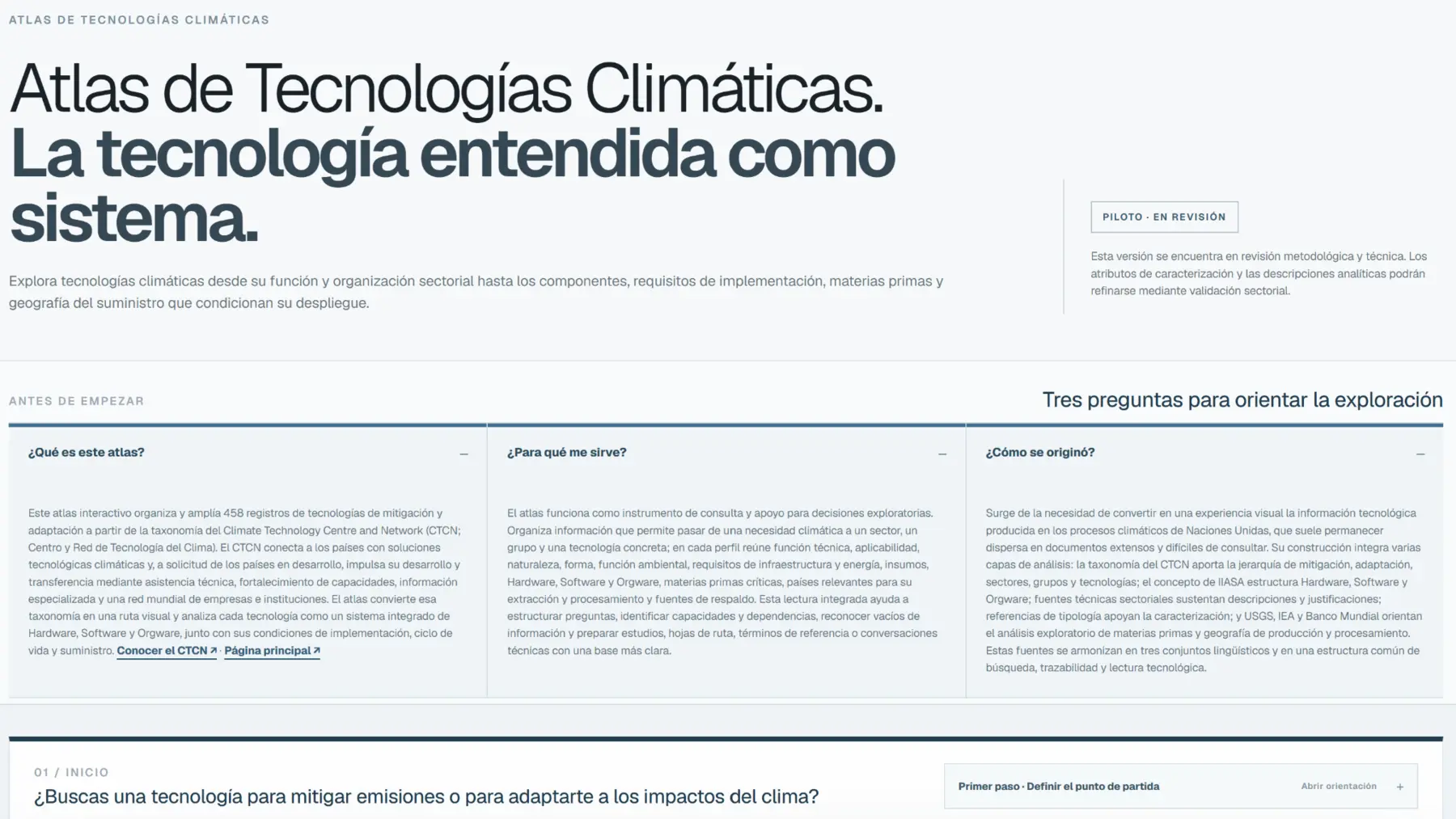
Open contents+
From human intervention to the technological paradox
Most of us understand that every form of work or activity we undertake affects, directly or indirectly, our relationship with the planet and the natural world. We cultivate land to produce food, transform energy, design machines, move ourselves and our goods, build vast infrastructure, formulate policies, rules and laws, teach, provide care, practise hundreds of arts through which we express ourselves, form families and carry out many other activities. All of this has always required, and will continue to require, resources that ultimately come from our planet.
The ability to make decisions that protect, transform or, conversely, degrade the conditions that sustain life is therefore part of everyday life, even when people are not conscious of that effect. None of the activities mentioned above is entirely separate from the climate crisis. Those of us who work directly in this field are not outside the systems that produced it or their contradictions either. Our particular responsibility is to study their effects, make them visible and help direct processes, decisions and projects towards a path that is not self-destructive - or at least that is what we seek to do.
The climate crisis is the accumulated result of all these decisions, especially those concerning how we produce energy, move, manufacture goods, build cities and transform ecosystems, together with the ways humanity has chosen to use natural resources in those activities. These decisions responded to the needs, shared and private interests, and knowledge of each period. They expanded the possibilities for development, comfort, housing and work and, to some extent, provided the means of subsistence for those generations. Yet many caused damage and inequalities that were not anticipated or that, even when known, were ignored; personally, I perceive the latter as the more recurrent situation. Although responsibility and impacts have been distributed profoundly unequally, the scientific evidence is clear about the human origin of observed warming and the severity of its consequences. Whether an individual has contributed greatly or only marginally, and whether they have experienced the effects to a greater or lesser degree, we are all part of the problem, adapted from (Intergovernmental Panel on Climate Change, 2023).
Technology as an amplifier of human action
What intensified this crisis? Several factors could be listed: overpopulation, inequality, excessive ambition, haste and irresponsibility. From a perspective centred on human behaviour, each could be described as a negative trait. Yet one factor breaks with the idea that the crisis can be attributed solely to our worst qualities: our capacity to create. This is where the central subject of this publication appears - technology. At different scales, this capacity has multiplied the impact of our decisions to the point of contributing to the present climate crisis.
As a mechanical engineer, I take pride in everything that our capacity to create has allowed us to materialise throughout history. Machines, energy systems, infrastructure, industrial processes and the organisation of production have enabled us to transform matter, energy and territory at an unprecedented speed and magnitude, in pursuit of personal and collective well-being and, to some extent, the satisfaction of the human mind.
At the same time, these dynamics have taken both the wealth and well-being concentrated among a small share of the population and the poverty and suffering borne by a large share of it to disproportionate levels. Technology, however, did not act alone in this crisis. Its material, cognitive and organisational components were the means through which human beings expanded their capacity to intervene. Models dependent on fossil fuels and intensive resource extraction have, in particular, deepened social inequalities and undermined the capacity of ecosystems to sustain life. The 2024 Global Resources Outlook examines this relationship between inequality and resources in detail (United Nations Environment Programme, 2024).
The technological paradox of climate action
At this point I propose the technological paradox of climate action: to reduce the impacts of the technological systems that helped cause the crisis, we need to develop and deploy new technologies; however, producing and implementing them also requires energy, raw materials, infrastructure and land, and may reproduce or intensify some of the impacts they are intended to address.
This paradox calls for a change in how technology is understood and assessed. As a society, we must recognise that technological innovation is not automatically favourable to the climate and that the crisis cannot be solved by simply replacing one set of equipment or processes with another. Nor must every technology become climate-compatible immediately. In many contexts, technologies that intensify climate change remain necessary because they also sustain life and meet essential human needs.
This way of understanding technology prompts us to seek additional pathways, one of which is to reduce its negative impacts. We know that these depend primarily on its energy source; the origin and processing of the raw materials it uses; its manufacture, service life and end-of-life management; the capacities required to operate it; the institutions that guide its implementation; who can access it; and the purposes and production models it serves.
The underlying question
The fundamental question addressed in this article is therefore: to what extent does a technology constitute an appropriate climate response?
This question is not new. I have encountered it in the professional and academic settings in which I have participated, and it is also present in the work of public institutions, companies, international organisations, universities and civil society organisations. From their respective fields of action, these actors have developed studies, methodologies, taxonomies and databases to identify, characterise and assess technologies that can help mitigate greenhouse gas emissions, strengthen adaptation to climate-change impacts, and avert, minimise and address associated loss and damage, while at the same time performing the operations and processes for which they were conceived.
The challenge, therefore, does not lie solely in having information available, but in being able to interpret it jointly. These sources were created for different purposes and scales of analysis and use different definitions and classification criteria. Some focus on the climate function of technologies; others on their components, maturity, transfer potential or implementation conditions. As a result, the same technology may appear under different names, levels of disaggregation and characteristics, making it difficult to connect records, compare their contents and convert them into useful information for decision-making.
To provide a tool that makes this large volume of information easier to visualise and consult in a harmonised form across different sources, this article presents a structured analysis of several of the most relevant information resources in the field. It examines their rationale, origins, characteristics, orientation, advantages and limitations, and finally presents a digital tool built from those sources. The application was developed with HTML, CSS and JavaScript, published with open access through GitHub Pages, and supported by artificial-intelligence tools for data organisation and management.
Harmonising information from such diverse sources, however, requires more than bringing records together on a single platform or aligning their categories. It requires relationships to be established among contents developed for different purposes and at different levels of detail, without erasing the distinctive features or context of each source.
Before deciding which information sources to use, how they can be applied and how they should be organised, it is necessary to make explicit the perspective from which technology will be assessed. This means recognising what type of data is being analysed, what claims can be made, what evidence supports them and what responsibilities arise from their social and environmental effects in the settings where this proposal may be used.
A critical and ethical perspective for assessing technology
Answering the fundamental question posed above requires two elements to be articulated. The first is ethical and political: it examines a technology's purposes, the power relations embedded in it, and the distribution of its benefits, risks and impacts. The second is epistemological: it determines how an assessment can be supported by evidence, how uncertainty should be treated and under what conditions conclusions should be revised. Rather than adopting a single philosophical school, this publication brings together perspectives that approach these dimensions from different angles, with the aim of protecting the analysis from subjective conclusions as far as possible.
Technology, power and non-neutrality
The main framework aligns with Andrew Feenberg's critical theory of technology. From this perspective, technological systems are neither autonomous forces nor entirely neutral instruments: their design, orientation and operation incorporate social decisions, interests, values and institutions, favouring certain ends while making others more difficult. Those who control their design and operation may receive the benefits while transferring costs, risks and responsibilities to other communities, territories, generations or ecosystems (Feenberg, 2005). A technology should therefore be analysed not only in terms of what it can do, but also who directs it, what it is used for and who bears its consequences.
Responsibility for long-term effects
This transformative capacity introduces a responsibility proportionate to the reach acquired by technological power in an ideal scenario. Here I draw on Hans Jonas's ethics of responsibility. Jonas warns that the consequences of modern technology may extend beyond the immediate space and time of a decision, accumulate in natural systems and compromise the living conditions of future generations. A technology cannot therefore be valued solely for its present usefulness or the intentions with which it was developed, but must also be examined in terms of the extent, duration and potential irreversibility of its effects (Berdinesen, 2017).
This responsibility finds a concrete expression in climate-resilient development. The IPCC presents it as a process that integrates mitigation and adaptation to support sustainable development, recognising that climate, ecosystems - including biodiversity - and society form coupled systems (Intergovernmental Panel on Climate Change, 2022). Responding to climate change therefore requires the consequences of decisions for people and natural systems to be considered simultaneously.
Ecological integrity and climate justice
This perspective converges with environmental ethics, which extends moral consideration to other forms of life, ecosystems and the natural processes that sustain life. Within this framework, ecosystem integrity becomes a criterion for analysis, understood as the capacity of ecosystems to maintain fundamental ecological processes, recover from disturbance and adapt to new conditions (Intergovernmental Panel on Climate Change, 2022).
At the same time, this responsibility connects with climate ethics and finds a concrete expression in climate justice. This perspective enables us to examine the distribution of historical responsibility and climate-change impacts, as well as the burdens and benefits of the measures adopted in response. It also considers differences in resources and response capacities, and who participates in decisions that may affect countries, territories, populations and generations unequally (Ara Begum, 2022), (Gardiner, 2004) and (Heyward, 2024).
Applying these criteria to technology analysis requires us to ask who can access a technology, who participates in its orientation, design and implementation, who receives its benefits, and who bears its costs and risks. This brings us back to a point made earlier:
A technology does not constitute an appropriate climate response solely because it reduces emissions or vulnerability. Its adoption may also create new harm or deepen inequalities, even when it fulfils its stated purpose.
Global bioethics and the conditions for the continuity of life
This expansion of responsibility also converges with the global bioethics proposed by Van Rensselaer Potter, conceived as a bridge between biological and ecological knowledge and the human values required to preserve life and the conditions for its continuity (Zanella, 2019). In this publication, however, bioethics serves only an informative function. The emphasis remains on the principal framework: the ethics of technology, enriched by environmental ethics, ecological integrity and climate justice because of their direct relationship with the object of analysis and the question addressed in this article.
Testing, uncertainty and revision
The proposed perspective indicates which dimensions should be considered, but it does not allow us to assume that the conclusions reached are definitive. At this point, recalling my first semesters of engineering at university, Karl Popper's critical rationalism offers a methodological orientation:
the claim that a technology constitutes an appropriate climate response should be understood as a provisional proposition, open to testing, criticism and revision.
The label "climate technology" does not in itself demonstrate that a technology is suitable for addressing this crisis. The claim must be tested against evidence about its performance, implementation conditions, and expected and observed effects. When results appear that contradict or limit its attributed benefits, the assessment should be modified rather than the initial conclusion protected (Popper, 2002).
Together, these dimensions guide a critical, systematic and evidence-based review. Each technology is examined using explicit criteria that consider its function and performance, implementation conditions, life cycle, distribution of benefits and risks, effects on environmental integrity, implications for climate justice and potential future consequences.
The objectivity sought does not eliminate ethics or human values. Instead, it aims to make the criteria explicit and, as far as possible, protect their consistent application from biased assessments, while maintaining source traceability and acknowledging existing uncertainties. The purpose is not to issue a definitive judgement that a particular technology must be used in a given situation, but to build an organised, transparent and verifiable basis for comparing the information available, revising conclusions as new evidence emerges and supporting better-informed decisions with wide-ranging consequences.
Once the perspective guiding this review has been established, the object of analysis must be described in greater detail: technology.
Technology
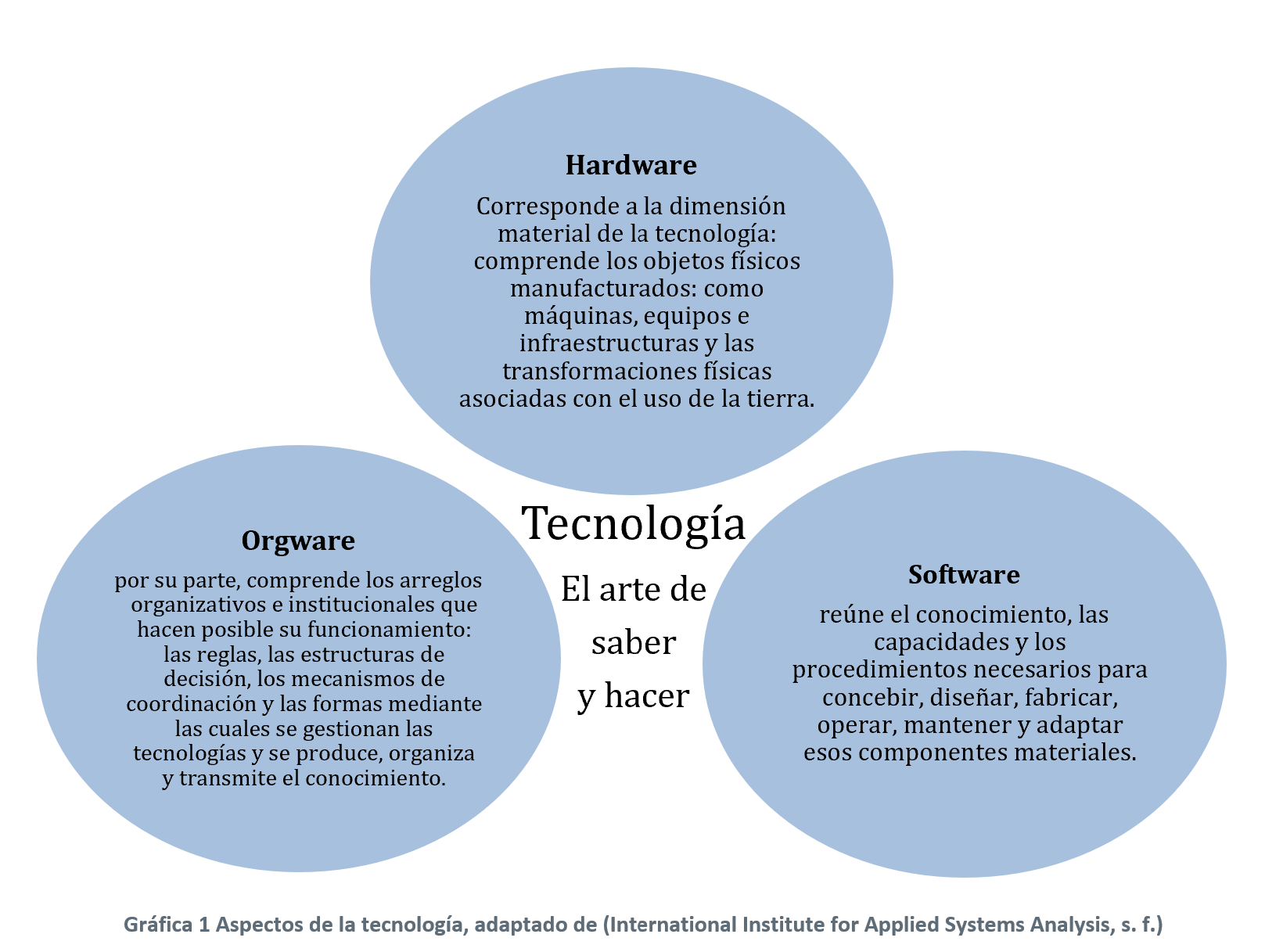
Discussing technology for climate action requires us to move beyond an understanding limited to devices, machines or processes. The starting point is the work of the International Institute for Applied Systems Analysis, which defines technology in simple terms but with a much broader scope than is generally assumed: the art of knowing and doing (International Institute for Applied Systems Analysis, n.d.). This definition distinguishes three conceptual aspects: hardware, software and orgware.
Hardware, software and orgware
From this perspective, a technology is not merely an artefact or a process. It is the articulation of its physical dimension, the knowledge that makes its use possible and the organisational environment that supports its operation, as shown in Figure 1.
This distinction provides a clear way to broaden the analysis of a technological solution. A piece of equipment may be available and achieve its nominal performance in a laboratory even though the knowledge required to maintain it, the infrastructure required to connect it, the rules required to authorise it or the agreements required to distribute its costs and benefits do not exist. Performance therefore does not reside exclusively in the physical component, but in the articulation of the artefact, human capacities and the organisational system within which it acquires a function.
Characterising the technological context
Understanding a technology comprehensively also requires its applicability, nature, form and environmental role to be characterised. Together, these can be read as a characterisation of its context, as illustrated in Figure 2:
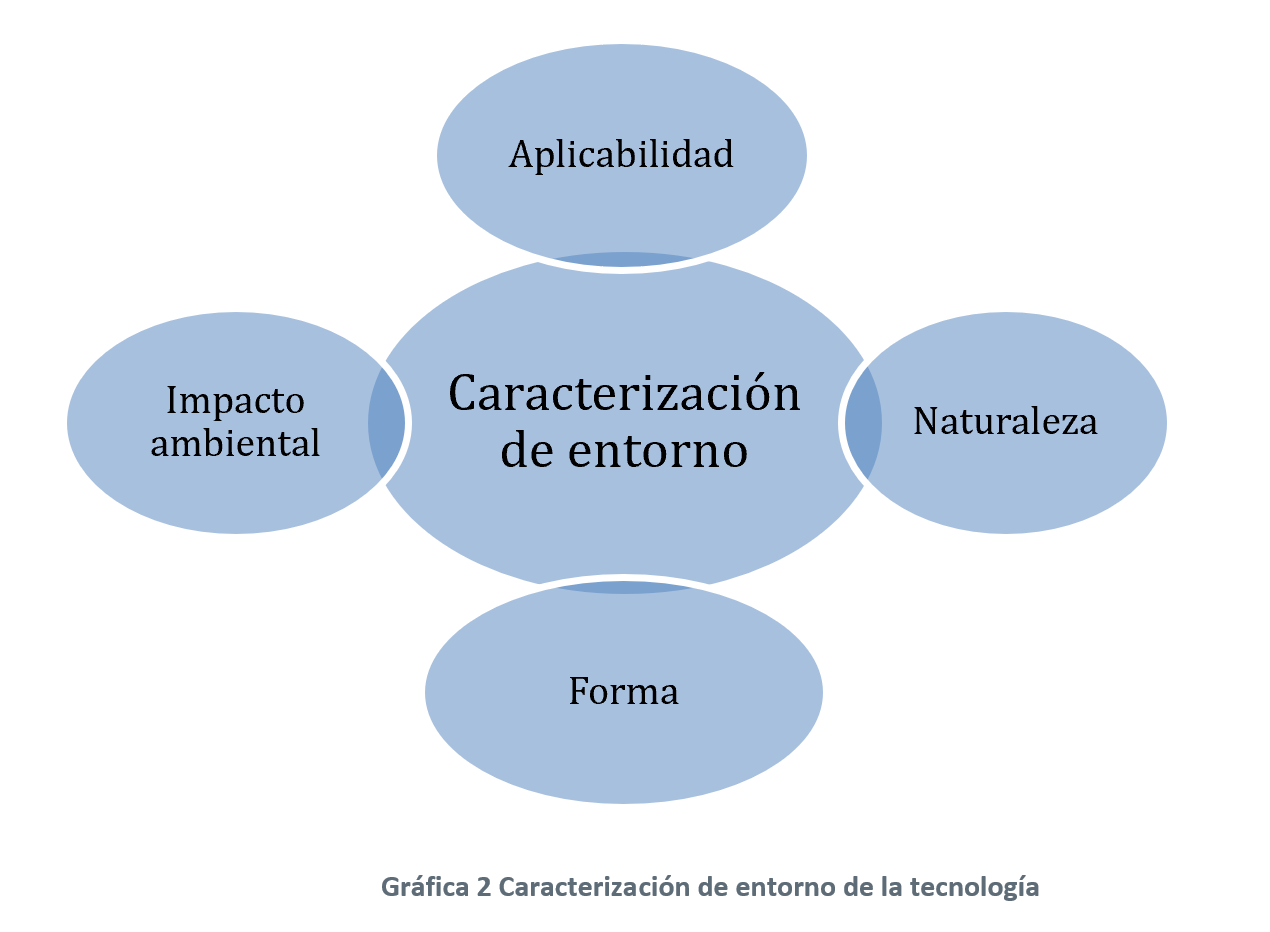
Applicability distinguishes generalisable, adaptable and site-specific solutions;
Nature shows the relative weight of material, cognitive and organisational components;
Form indicates whether the technology is embodied in equipment, a process, a service, a practice or a combination of these;
Environmental role requires verification of whether its contribution to mitigation, adaptation, or loss and damage management is direct, enabling or conditional, together with an understanding of its life cycle and environmental impacts.
Cross-cutting technological characteristics for implementation
Characterising a technology must make visible the conditions that enable its implementation and operation. These conditions are not always part of the technology's process scheme, yet they determine whether it can operate safely, continuously and consistently with the purpose for which it was conceived. They include available infrastructure; the quantity, quality and origin of energy; materials and inputs; supply chains; spare parts; maintenance; and the necessary human and institutional capacities.
The availability of these elements is not sufficient in itself. Their origin, stability and compatibility with the context must also be understood. A technology may depend on materials whose extraction causes severe impacts, supplies concentrated geographically, specialised knowledge that is unavailable locally or has been privatised, or infrastructure whose construction substantially alters production costs and biases the distribution of benefits.
This situation is especially visible in the critical minerals used in energy-transition technologies. The extraction and processing of minerals such as cobalt, lithium, nickel, graphite and rare earth elements are concentrated in a small number of countries, introducing vulnerabilities into supply chains (International Energy Agency, 2025).
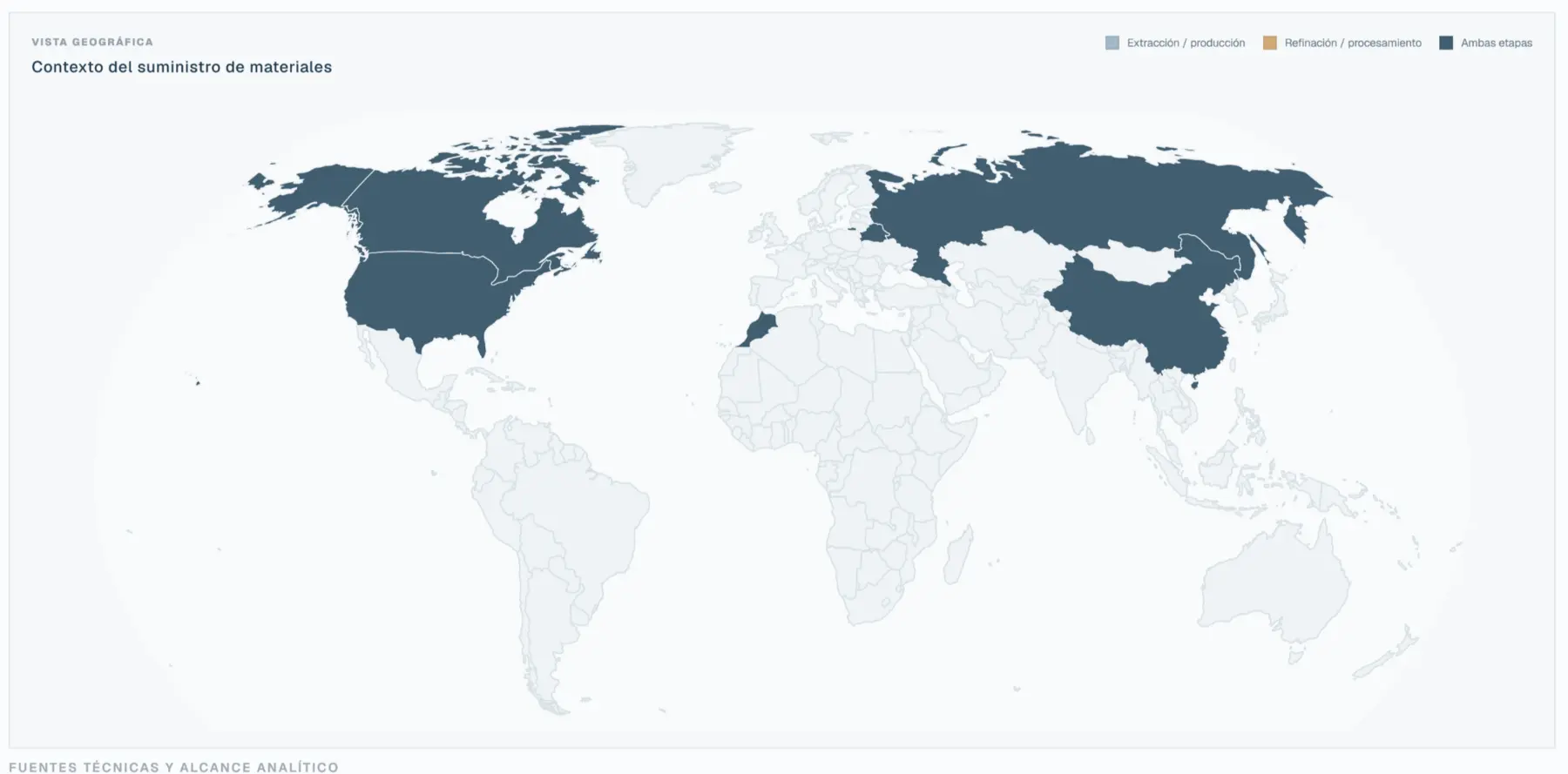
The problem, however, is not limited to availability. Child labour, dangerous working conditions, risks associated with security forces, corruption and the displacement of communities have been documented in copper and cobalt supply chains in the Democratic Republic of the Congo (African Union Commission, & Organisation for Economic Co-operation and Development, 2024).
Studies in Kolwezi have also found elevated levels of cobalt in the blood and urine of people living in mining areas, especially children, as well as indications of oxidative damage and environmental contamination associated with extraction and processing activities (Banza Lubaba Nkulu, 2018).
These tensions are not exclusive to the cobalt supply chain in the Democratic Republic of the Congo. In Latin America, lithium extraction from brines - particularly in Chile's Salar de Atacama - places pressure on water, biodiversity and the traditional economic activities of communities near the salt flats. It has also generated controversy over those communities' participation in decisions affecting their territories (Economic Commission for Latin America and the Caribbean, 2023).
In Asia, the expansion of nickel mining in Indonesia reveals another significant contradiction. Nickel is used in batteries for electric vehicles, yet the extraction and processing of lateritic ores require large amounts of energy, generate waste and transform land. Because the industry depends heavily on coal, it can also produce substantial greenhouse gas emissions. Water pollution, deforestation and harm to the livelihoods of local and Indigenous communities compound these effects (Intergovernmental Forum on Mining, Minerals, Metals and Sustainable Development, n.d.).
The climate appropriateness of a technology therefore also depends on the traceability of its materials, the conditions under which they were extracted and processed, and the distribution of benefits, costs, risks and responsibilities along its supply chain.
Likewise, an energy source that appears appropriate in one territory may produce different results in another because of the composition of its energy mix, environmental conditions or the capacities available for operation and maintenance.
Cross-cutting technological characteristics show that implementation is neither the final moment of a purchase nor the isolated installation of a piece of equipment. It is a process that articulates material components, knowledge, capacities, institutions and territorial conditions. Making these dependencies visible allows more precise questions to be asked about how, when, where, with whom, for what purpose and through which instruments a technology might be implemented.
This systemic reading becomes the methodology for analysing the data examined in this article, but it also raises a new challenge: how should information be organised so that the critical, ethical, environmental and epistemological dimensions discussed above are reflected in the way each technology is described and examined, rather than remaining merely general principles?
From the proposed perspective to an information structure
The perspective developed in this first part is not an external supplement to technology analysis. Each dimension directs attention to elements that need to be made visible when examining a technology. Critical theory of technology raises questions about its purposes, the actors involved in directing it and the distribution of benefits and risks. The ethics of responsibility requires the temporal and territorial reach of its effects and their potential irreversibility to be considered. Environmental and climate ethics incorporate its relationships with ecosystems, populations and affected generations. Finally, critical rationalism requires claims to be supported by evidence, uncertainty to be acknowledged and conclusions to remain open to revision.
Translating these perspectives into an information structure means turning their questions into observable and verifiable elements. It is not enough to assert that responsibility, justice or environmental integrity should be considered. The data through which they can be examined, their origins, how they were interpreted and the gaps that remain must be identified. This step connects the conceptual framework with the structure that will subsequently guide the construction of the tool.
Objectivity, traceability and revision
In this publication, objectivity is not understood as the complete absence of values, decisions or interpretations. Selecting a source, delimiting a technology, establishing categories and determining which information is relevant are analytical decisions. Objectivity is therefore understood in an operational sense: presenting substantiated information, applying explicit criteria consistently and allowing others to recognise how each result was obtained.
This requires a distinction between what a source states and the interpretation made during harmonisation. Each record should identify the origin of the information, its date, geographical and sectoral scope, level of detail and direct relationship with the technology described. When a classification has been assigned as part of the analysis, it should be identified as such and the criterion used should be explained.
Traceability also requires differences and potential contradictions among sources to be preserved. Harmonisation does not mean eliminating those differences or producing an artificially uniform synthesis. When two documents use different names, define different boundaries or present incompatible results, the tool should make that situation visible. Likewise, absent information should remain an identifiable gap rather than being filled with assumptions presented as facts.
Revision is the third component of this approach. Every claim about the performance or climate appropriateness of a technology should remain open to new evidence. Information therefore needs to include consultation and update dates, review status and validation level. Artificial-intelligence tools can support the search, organisation, comparison or synthesis of data, but their outputs do not constitute a source in themselves. Any content generated or transformed with their support must remain connected to documentary evidence and be subject to human verification.
Evidence, characterisation and contextual assessment
To prevent a description from being mistaken for a recommendation, information can be organised into three related but methodologically distinct levels: documentary evidence, analytical characterisation and contextual assessment.
| Level | Main question | Content |
|---|---|---|
| Documentary evidence | What does the source state? | Description, data, authorship, date, scope, context and references consulted. |
| Analytical characterisation | How can the information be organised and interpreted? | Harmonised name, hardware, software, orgware, applicability, nature, form, environmental role and implementation requirements. |
| Contextual assessment | Does the technology constitute an appropriate response in a given situation? | Baseline, performance, life cycle, costs, risks, capacities, territorial conditions, actors involved and available alternatives. |
Table 1. Levels of information for technology analysis. Author's elaboration based on the analysis developed in this first part.
Documentary evidence is the starting point. Its function is to preserve what can be verified in the sources without attributing a scope they do not possess. A taxonomy may establish that a technology belongs to a particular sector or group, but that classification does not demonstrate its feasibility, performance or suitability for a territory.
Analytical characterisation allows different sources to be related through a common structure. This level contains the categories adopted to describe the components and conditions of a technology. Although these categories are based on conceptual frameworks, they remain a form of interpretation and should be applied through transparent rules.
Contextual assessment requires additional information and cannot be inferred automatically from the previous two levels. Determining whether a technology is appropriate requires the problem to be delimited, a baseline to be established, alternatives to be compared and the economic, environmental, social, technical and institutional conditions of the place where it might be implemented to be considered. It also requires the actors participating in the decision, or potentially affected by it, to be included.
The tool should organise documentary evidence and analytical characterisation and thereby prepare the ground for a better-informed assessment. It must never replace contextual analysis or present a general classification as though it were a decision applicable in every territory.
Information needed to understand a technology
Based on this distinction, a comprehensive technology profile should contain at least six groups of information:
Identification and provenance: original and harmonised name, description, source, consultation date, geographical and sectoral scope, and level of disaggregation.
Function and climate relationship: the need it addresses, the service it provides, the mechanism through which it may contribute to mitigation, adaptation or loss and damage management, and the conditions limiting that contribution.
System configuration: physical components corresponding to hardware; knowledge, capacities and processes associated with software; and the rules, institutions, agreements and decision structures that constitute orgware.
Characteristics and implementation requirements: applicability, nature, form, environmental role, technology maturity, infrastructure, energy, materials, inputs, supplies, maintenance and required capacities.
Consequences and distribution: potential life-cycle impacts, effects on ecosystems, temporal and territorial reach, beneficiaries, affected actors, conditions of access, and the distribution of costs and risks.
Evidence and validation: references supporting each claim, assumptions used, uncertainties, missing information, possible contradictions, update date and technical-review status.
These groups do not imply that every source must contain all the information. Their purpose is to show which dimensions have been documented and which remain open. A record that makes its gaps explicit is more useful and reliable than one that appears complete but was constructed through unverified inference.
This structure also preserves the distinction between characterising and assessing a technology. A profile can show what a technology is, how it works, what it depends on and which consequences should be examined. Determining whether it should be implemented, by contrast, requires that information to be tested against a problem, a baseline, a territory, alternative options and the priorities of the actors involved, which is beyond the initial scope of this work.
Conclusions of Part I: a conceptual basis for the tool
The technological paradox of climate action is not simply that technology can cause harm while also offering solutions. Its meaning lies in the fact that the capacities used to expand human intervention on the planet remain necessary for addressing its consequences, yet still depend on energy, materials, infrastructure, knowledge, institutions and decisions that can also reproduce the impacts they are intended to reduce.
For this reason, considering a technology an appropriate climate response cannot depend solely on its name, novelty or operational performance. Its appropriateness is relational: it depends on the problem it seeks to solve, the technological system to which it belongs, the context in which it is implemented, the evidence available and the distribution of its benefits, costs and risks.
The critical, ethical and epistemological perspective developed in this first part establishes the elements that should be made visible when examining that relationship. The definition of technology, and its characterisation through hardware, software and orgware, broadens the object of analysis. Characterising its context identifies its forms of application and dependencies, while the principles of operational objectivity, traceability and revision establish how the information should be organised.
The result of this first part is not a definitive conclusion about which technologies should be used, but a framework for asking better questions and constructing verifiable information. Part II will apply this framework to distinguish among characterisation, assessment, prioritisation and decision-making; examine the sources used and their limitations; explain the harmonisation process and the construction of the Climate Technology Atlas; and demonstrate its application through a specific technology case.
References
African Union Commission, & Organisation for Economic Co-operation and Development. (2024). Africa’s development dynamics 2024: Skills, jobs and productivity. OECD. doi:https://doi.org/10.1787/df06c7a4-en
Ara Begum, R. L. (2022). Point of departure and key concepts. (C. University, Ed.) Climate change 2022: Impacts, adaptation and vulnerability. doi:https://doi.org/10.1017/9781009325844.003
Banza Lubaba Nkulu, C. C.-K.-M. (2018). Sustainability of artisanal mining of cobalt in DR Congo. Nature Sustainability (Vol. 1(9)). doi:https://doi.org/10.1038/s41893-018-0139-4
Berdinesen, H. (2017). On Hans Jonas’ “The imperative of responsibility.”. Philosophia, 16–28. Retrieved from https://philosophia-bg.com/archive/philosophia-17-2017/on-hans-jonas-the-imperative-of-responsibility/
Climate Technology Atlas. (2026). Climate Technology Atlas. Retrieved August 13, 2026, from https://stvdio-luisgui.github.io/technology-atlas.html
Climate Technology Centre and Network. (n.d.). CTCN technology taxonomy. Retrieved from https://www.ctc-n.org/sites/www.ctc-n.org/files/resources/CTCN%20Technology%20Taxonomy.pdf
Comisión Económica para América Latina y el Caribe. (2023). Extracción e industrialización del litio: oportunidades y desafíos para América Latina y el Caribe. Retrieved from https://repositorio.cepal.org/server/api/core/bitstreams/5c1c160a-557d-42d9-bfa8-929142d2fa21/content
Feenberg, A. (2005). Teoría crítica de la tecnología (C. Alfaraz, Trad.). Revista Iberoamericana de Ciencia, Tecnología y Sociedad - CTS, 109–123. doi:https://doi.org/10.52712/issn.1850-0013-1018
Gardiner, S. M. (2004). Ethics and global climate change. Ethics, 114(3), 555–600. doi:https://doi.org/10.1086/382247
Haselip, J., Narkevičiūtė, R., Rogat, J., & Trærup, S. (2019). TNA step by step: A guidebook for countries conducting a Technology Needs Assessment and Action Plan. UNEP DTU Partnership. Retrieved from https://tech-action.unepccc.org/wp-content/uploads/sites/2/2019/04/2019-02-tna-step-by-step-guide.pdf
Heyward, C. &. (2024). Rectifying secondary climatic injustices. (E. J. (Eds.), Ed.) Studies on climate ethics and future generations, 6, 139–155. Retrieved from https://www.iffs.se/media/24255/climateethics_vol6.pdf
Hund, K., La Porta, D., Fabregas, T., Laing, T., & Drexhage, J. (2020). Minerals for climate action: The mineral intensity of the clean energy transition. World Bank. Retrieved from https://documents1.worldbank.org/curated/en/099052423172525564/pdf/P16627806f5aa400508f8c0bdcba0878a3e.pdf
Intergovernmental Forum on Mining, Minerals, Metals and Sustainable Development. (n.d.). Nickel mining in Indonesia: An overview of socioenvironmental governance in the sector (IGF Case Study). (I. I. Development, Ed.) Retrieved from https://www.iisd.org/system/files/2026-05/nickel-mining-indonesia.pdf
Intergovernmental Panel on Climate Change. (2022). Summary for policymakers AR6: Climate change 2022: Impacts, adaptation and vulnerability. Contribution of Working Group II to the Sixth Assessment Report of the Intergovernmental Panel on Climate Change. doi:https://doi.org/10.1017/9781009325844.001
Intergovernmental Panel on Climate Change. (2023). Climate change 2023: Synthesis report. Retrieved from https://doi.org/10.59327/IPCC/AR6-9789291691647
International Energy Agency. (2025). Global critical minerals outlook 2025. Retrieved from https://iea.blob.core.windows.net/assets/ef5e9b70-3374-4caa-ba9d-19c72253bfc4/GlobalCriticalMineralsOutlook2025.pdf
International Energy Agency. (2026). Global critical minerals outlook 2026. Retrieved from https://www.iea.org/reports/global-critical-minerals-outlook-2026
International Energy Agency. (n.d.). Hydrogen Production and Infrastructure Projects Database. Retrieved August 13, 2026, from https://www.iea.org/data-and-statistics/data-product/hydrogen-production-and-infrastructure-projects-database
International Institute for Applied Systems Analysis. (n.d.). What is technology? Retrieved from https://iiasa.ac.at/what-is-technology
International Organization for Standardization. (2013). Space systems—Definition of the technology readiness levels (TRLs) and their criteria of assessment. Retrieved from https://www.iso.org/standard/56064.html
Popper, K. R. (2002). Conjectures and refutations: The growth of scientific knowledge (2nd ed.). Routledge.
Technology Executive Committee. (2015). Good practices of Technology Needs Assessments. United Nations Framework Convention on Climate Change. Retrieved from https://unfccc.int/ttclear/misc_/StaticFiles/gnwoerk_static/TEC_documents/5be1bf880cc34d52a4315206d54a711b/ed472cdbc2a84f5ba2831f268524903d.pdf
U.S. Geological Survey. (2026). Mineral commodity summaries 2026. Retrieved from https://doi.org/10.3133/mcs2026
United Nations Environment Programme. (November 19, 2024). A policymakers’ guide to life cycle assessment: Policy brief. Retrieved from https://www.unep.org/resources/policy-and-strategy/policymakers-guide-life-cycle-assessment-policy-brief
United Nations Environment Programme. (2024). Global Resources Outlook 2024: Bend the Trend – Pathways to a liveable planet as resource use spikes. Nairobi: International Resource Panel. Retrieved from https://wedocs.unep.org/20.500.11822/44901
Zanella, D. C. (2019). V. R. Potter’s global bioethics. Ambiente & Sociedade, e02081, 22. Retrieved from https://www.scielo.br/j/asoc/a/4fprx7pMp9jskL9xMYSsWbd/?lang=en
Part II will put the framework into practice.
It will examine the sources, data harmonisation and application of the method in the construction and use of the Atlas.